
Active Warrants in Luzerne County
Warrants in Luzerne County are issued by the courts and worked by law enforcement. A judge or magisterial district judge signs the order. The Sheriff's Department, along with municipal and state police, then serves it. The Sheriff handles warrant and bench-warrant execution as one of its core duties, alongside courthouse security, civil process, and Protection From Abuse service. Bench warrants often issue after a person fails to appear, violates probation, or is held in contempt.
Here is the part that trips people up. Luzerne County does not run a public online list that names everyone with an active warrant. There is no verified public active-warrant database for the county. Any site claiming to be one is not official. The honest way to check is through the court docket and by contacting the offices that hold the records, which is what the sections that follow lay out.
The Sheriff's Department is the central office for warrant work. You can review its duties on the Luzerne County Sheriff's Department page, shown below.
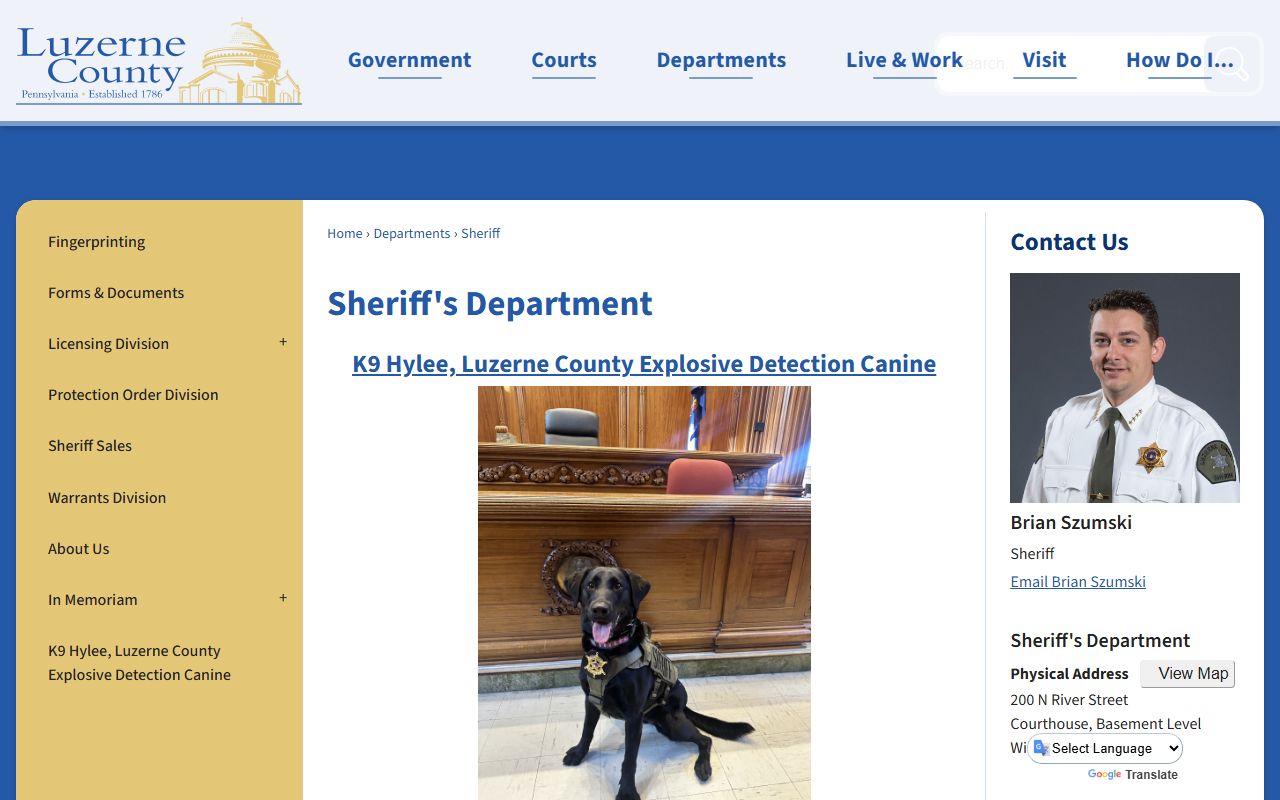
The page outlines how the Sheriff serves court orders, including warrants, across the county.
Types of Warrants in Luzerne County
Not all warrants do the same thing. Some authorize an arrest. Others let police search a place. A few deal with extradition between states. Knowing the type tells you which court issued it and how it gets cleared. These are the warrant types seen in Luzerne County.
- Arrest warrant - orders police to take a named person into custody for a charged offense.
- Bench warrant - issued by a judge after a missed court date, a probation violation, or contempt.
- Search warrant - lets police search a specific place or item for evidence.
- Domestic-relations warrant - used to enforce support or family-court orders.
- Governor's / extradition warrant - moves a person between states to face charges.
- Fugitive warrant - issued for a person wanted in another jurisdiction.
- Probation / parole detainer - holds a person for a supervision violation.
Most warrant work the Sheriff handles falls under the warrants function. The screenshot below comes from the same Sheriff's Department page, which describes that warrant role.
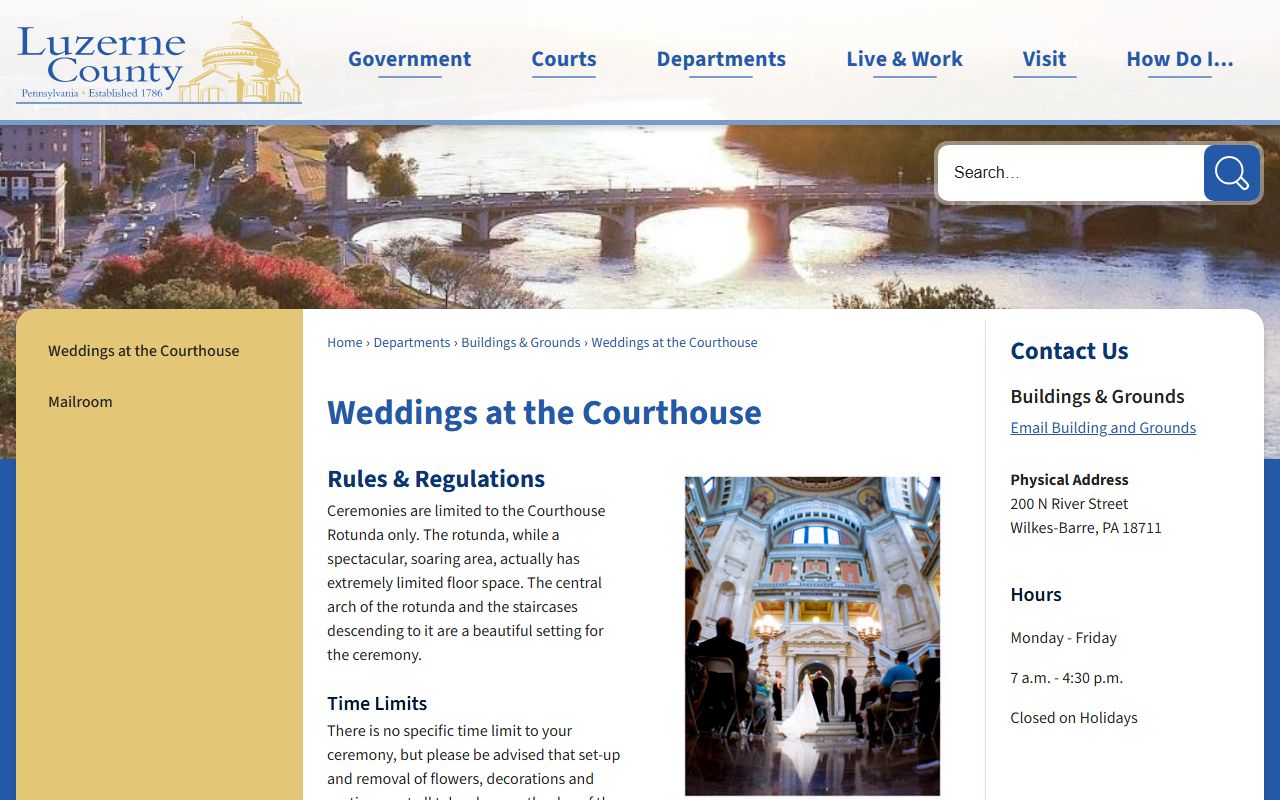
The Sheriff staff directory lists a dedicated line for Warrants and Record Checks, which is the right contact for warrant questions.
How to Search Luzerne County Warrants
Since there is no public warrant name list, the practical route is the court docket. Many warrants tie to a criminal or miscellaneous case, and that case shows up on the Pennsylvania UJS Web Portal. The docket can reveal a bench warrant, a violation of probation, or a contempt action. You can also call the Sheriff's Department directly to ask about a warrant.
- Open the UJS case search and set County to Luzerne.
- Search by Participant Name, OTN, or Docket Number, then choose Criminal or Miscellaneous as the Docket Type.
- Open the docket and check the entries for any warrant, detainer, or contempt action.
For warrant or record-check questions, the Sheriff's Department main line is 570-825-1651, and the Warrants / Record Checks line is 570-825-1855. The court case information overview, shown below, explains how public case access works statewide and is available on the PA Courts case information page.
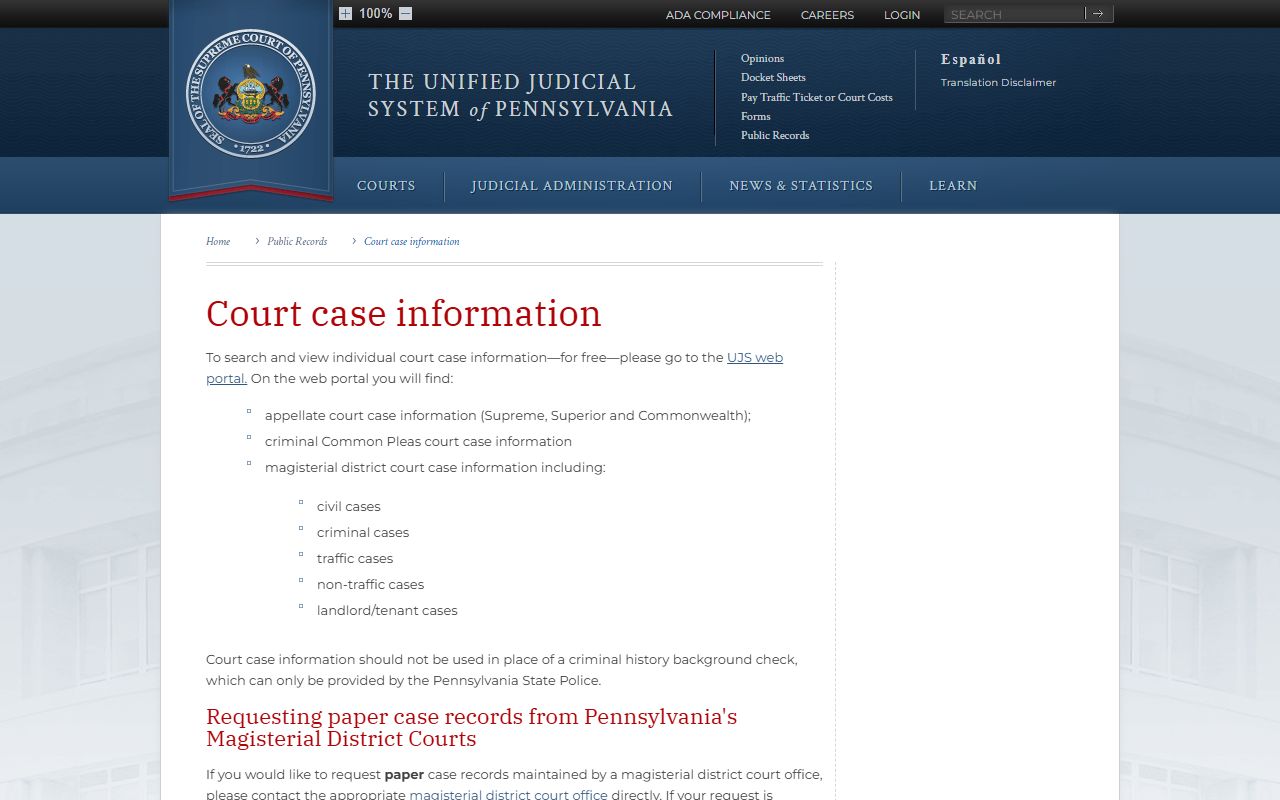
That page is a good reminder that warrant data is reached through case dockets and the issuing court, not through one combined list.
Luzerne County Warrant Search Fields
The UJS portal is where warrant-related cases surface. It does not have a field literally named warrant. Instead you pick a search type, set the county, and choose the docket type, then read the case for warrant entries. These are the fields that matter for a warrant lookup.
| Field Label | Type | Required | Notes |
|---|---|---|---|
| Search By | Dropdown | Yes | Docket Number, Participant Name, Complaint Number, Incident Number, OTN, or Date Filed |
| County | Dropdown | Conditional | Choose Luzerne |
| Docket Type | Dropdown | Conditional | Criminal or Miscellaneous for warrant-related cases |
| Participant Name | Text | Conditional | Last and first name; date range optional |
| Docket Number | Text | If selected | Luzerne CP code is 40, e.g., CP-40-CR-0009999-2024 |
Relevant case categories include Warrants, Search Warrant, Governor's Warrant, Fugitive, Violation of Probation, and Contempt. Match those to the warrant type you are checking.
What a Luzerne County Warrant Record Shows
When a warrant appears in a case docket, it carries a set of details. These fields tell you when it was issued, why, and which court is behind it. The exact data depends on the case and the type of warrant.
| Field | What It Shows |
|---|---|
| Warrant / Docket Number | The case or order number tied to the warrant |
| Issue Date | When the judge signed the warrant |
| Charge | The offense or reason behind the warrant |
| Bond Amount | The bail set, if any, to resolve custody |
| Issuing Court | The Common Pleas or Magisterial District Court behind it |
Note: A docket may mark a warrant as recalled or served, which tells you the matter was resolved rather than still open.
What to Do If You Have an Outstanding Warrant
Finding out you have a warrant is stressful, but there is a clear way to handle it. The worst move is to ignore it. A warrant does not expire on its own, and it can lead to an arrest at a traffic stop or a routine check. Take it step by step and use official channels only.
- Verify the warrant through official channels: the UJS docket, the Sheriff's Department at 570-825-1651, the Clerk of Courts, or the issuing Magisterial District Court.
- Do not rely on third-party warrant sites, which are often wrong or out of date.
- If you missed a court date, contact the issuing court or your attorney to reschedule or address it.
- For a criminal warrant, speak with a defense attorney, or the Public Defender if you qualify, before you appear.
- After it is resolved, confirm the docket shows the warrant recalled.
Important: Talk to a lawyer before you turn yourself in, since counsel can arrange bail and protect your rights at the surrender.
Megan's Law and Public Safety Searches
Warrant searches often overlap with other public safety lookups. One the public can search directly is the Pennsylvania Megan's Law registry, which lists registered sex offenders by county, municipality, ZIP, radius, or name. It is a separate system from warrants, but people checking on a neighborhood or a name often use both.
You can search the registry on the Pennsylvania Megan's Law site, shown below.
Unlike warrants, this registry is fully searchable by name and location, so it is a useful companion when you are checking on someone in Luzerne County.
Restricted Luzerne County Warrant Records
Some warrant information is not open to the public. Sealed warrants, especially search warrants in active investigations, may be withheld so the case is not tipped off. Juvenile matters are restricted under state law. Federal warrants do not appear in the county or state court systems at all, since those run through federal courts.
The court docket also masks confidential identifiers and may not display juvenile, expunged, or limited-access cases. So a clean search result is not always proof that no warrant exists. When the situation is serious, confirm directly with the Sheriff's Department or the issuing court rather than relying on a screen alone.
Public access to court case records in Pennsylvania follows the Case Records Public Access Policy of the Unified Judicial System. It sets what shows online and what stays sealed. That policy is why warrant data lives inside individual dockets rather than in one open list, and why some entries are held back.
How Warrants Move Through the Courts
A warrant has a life cycle. It starts when a judge signs it and ends when it is served or recalled. Knowing that path helps you read a docket and figure out where a warrant stands. The Sheriff and police carry out the order, while the court keeps the record.
Most warrants begin in one of two places. A Magisterial District Court issues many of the early warrants, since that is where preliminary proceedings happen. The Court of Common Pleas issues bench warrants in cases that have moved up, such as a missed hearing or a probation violation. Either way, the issuing court is the office that can recall the warrant once the matter is handled.
The flow usually runs like this: the court issues the warrant, the Sheriff or police serve it, the person is taken into custody or surrenders, bail or a hearing follows, and the docket is updated to show the warrant cleared. Each step leaves a mark in the case file. If you are tracking a warrant, the docket entries are the best record of what has happened and what is left to do.