
Luzerne County Court of Common Pleas Overview
Pennsylvania's main trial court is the Court of Common Pleas. Luzerne County makes up the 11th Judicial District, a single-county district seated at the Luzerne County Courthouse in Wilkes-Barre. The court hears the heavy cases. That means felony and serious criminal matters, civil suits, family cases like divorce, custody, and support, and Orphans' Court work such as estates, adoptions, and guardianships. It is a court of general jurisdiction, so it can hear almost any kind of case that is not reserved for a minor court or a federal court.
The court does more than hear cases. It also oversees several county offices that keep the justice system running. Those include Adult Probation and Parole, Juvenile Probation, and Domestic Relations, which handles support enforcement. The court system also supervises the county's Magisterial District Courts, the local minor courts. You can review the official state listing for the court on the Pennsylvania Courts Luzerne County page, which lists the court address, phone, and hours.
That state page is shown below.
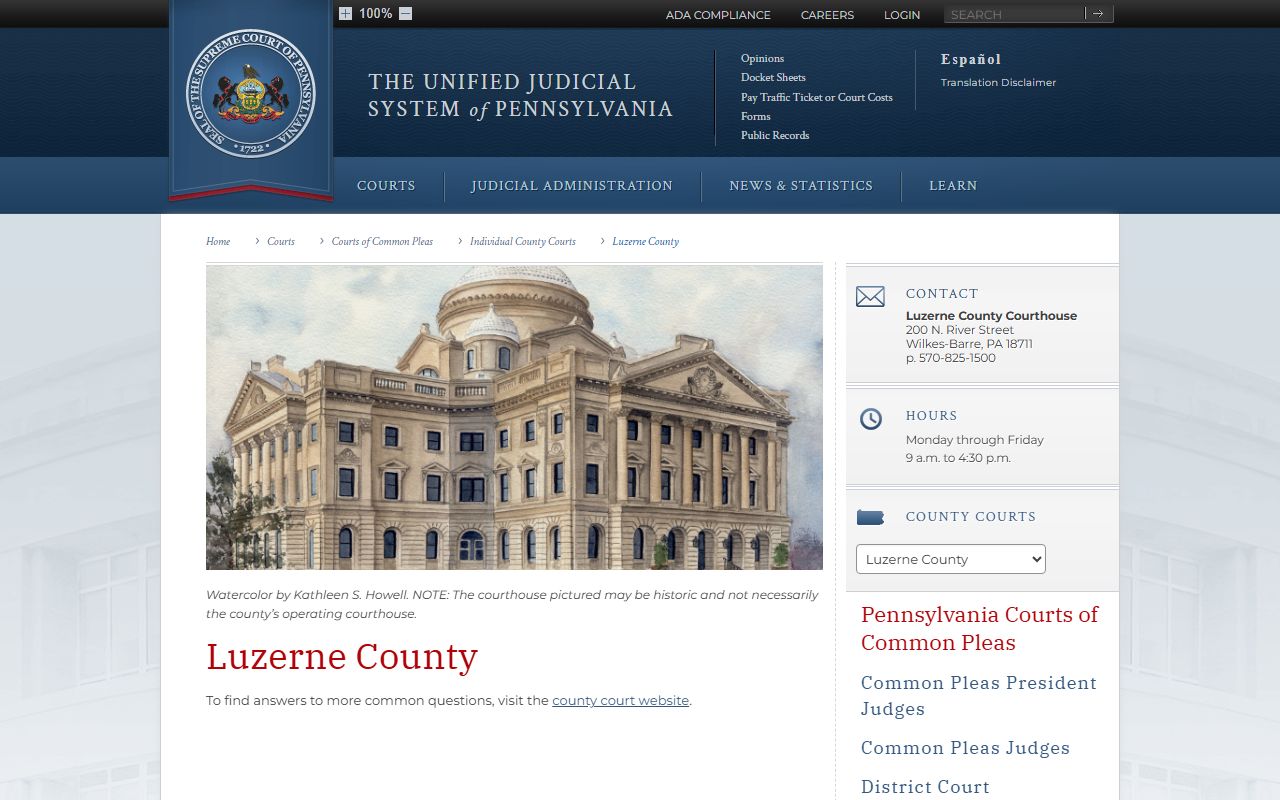
The page ties the county trial court into the statewide Unified Judicial System and its public docket tools.
Luzerne County Court of Common Pleas Judges
Common Pleas judges are elected to ten-year terms. They must stand for retention to keep the seat. The President Judge leads the court and handles administration along with a full caseload. In Luzerne County the President Judge is the Hon. Stefanie J. Salavantis. The bench is large because the county handles a heavy volume of criminal, civil, and family work.
The current Common Pleas judges per the county roster are David W. Lupas, Tina Polachek Gartley, Jennifer L. Rogers, Joseph F. Sklarosky Jr., Lesa S. Gelb, Richard M. Hughes III, Fred A. Pierantoni III, Michael T. Vough, and Tarah C. Toohil, along with Senior Judge William H. Amesbury. Senior judges are retired judges who still hear cases part-time to help with the load. You can see the full roster on the county's Judges page.
A view of that roster page is shown here.
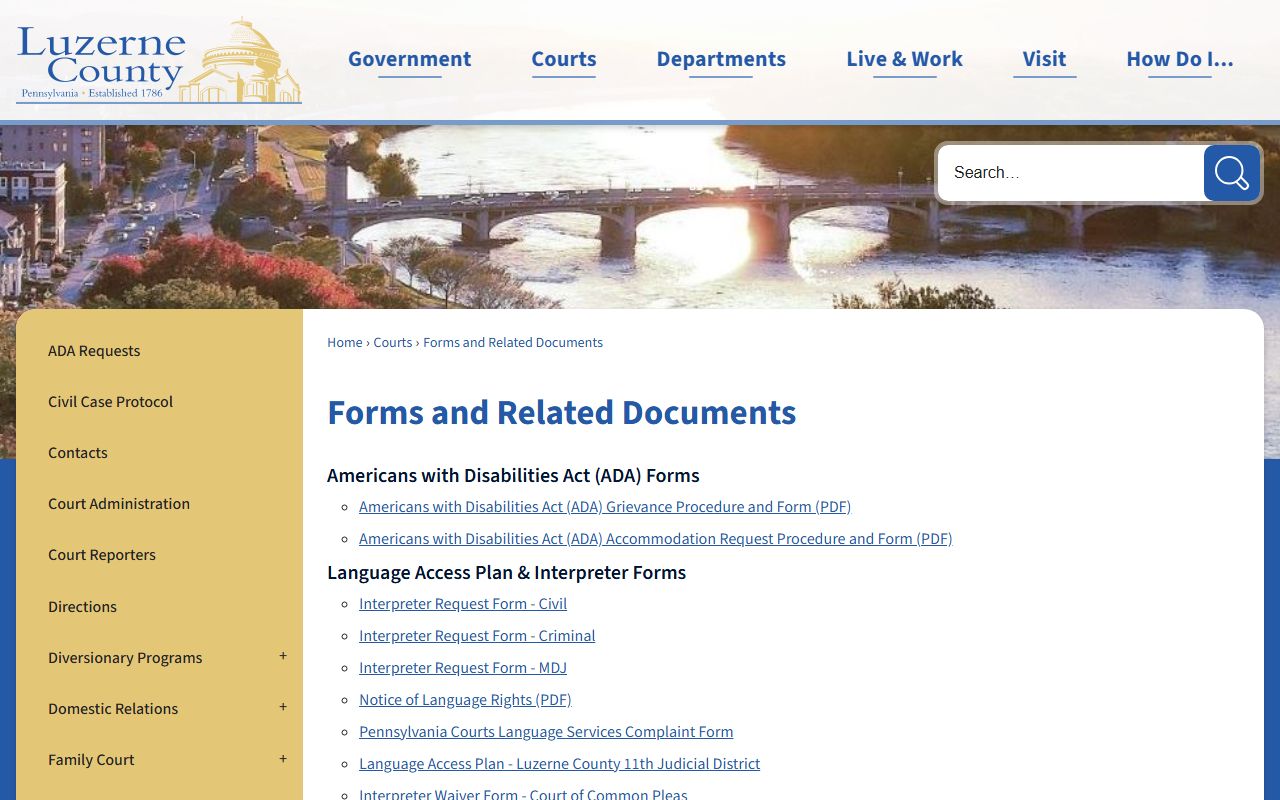
The roster is useful when a docket lists a judge's name and you want to confirm the assignment.
Luzerne County Magisterial District Courts
Below the Court of Common Pleas sit the Magisterial District Courts, the local minor courts. These are where most residents first see the court system. They handle traffic and non-traffic citations, landlord-tenant disputes, and small civil claims up to $12,000. They also take private criminal complaints, set bail, hold preliminary arraignments, and run preliminary hearings that decide whether a criminal case moves up to Common Pleas. District numbering runs 11-X-XX, where the 11 marks the judicial district.
Central Court, district 11-0-01, sits at 77 Water Street in Wilkes-Barre and handles preliminary arraignments and central processing. The Pennsylvania Courts site explains how these minor courts work statewide on its Magisterial District Judges page.
That overview page is shown below.
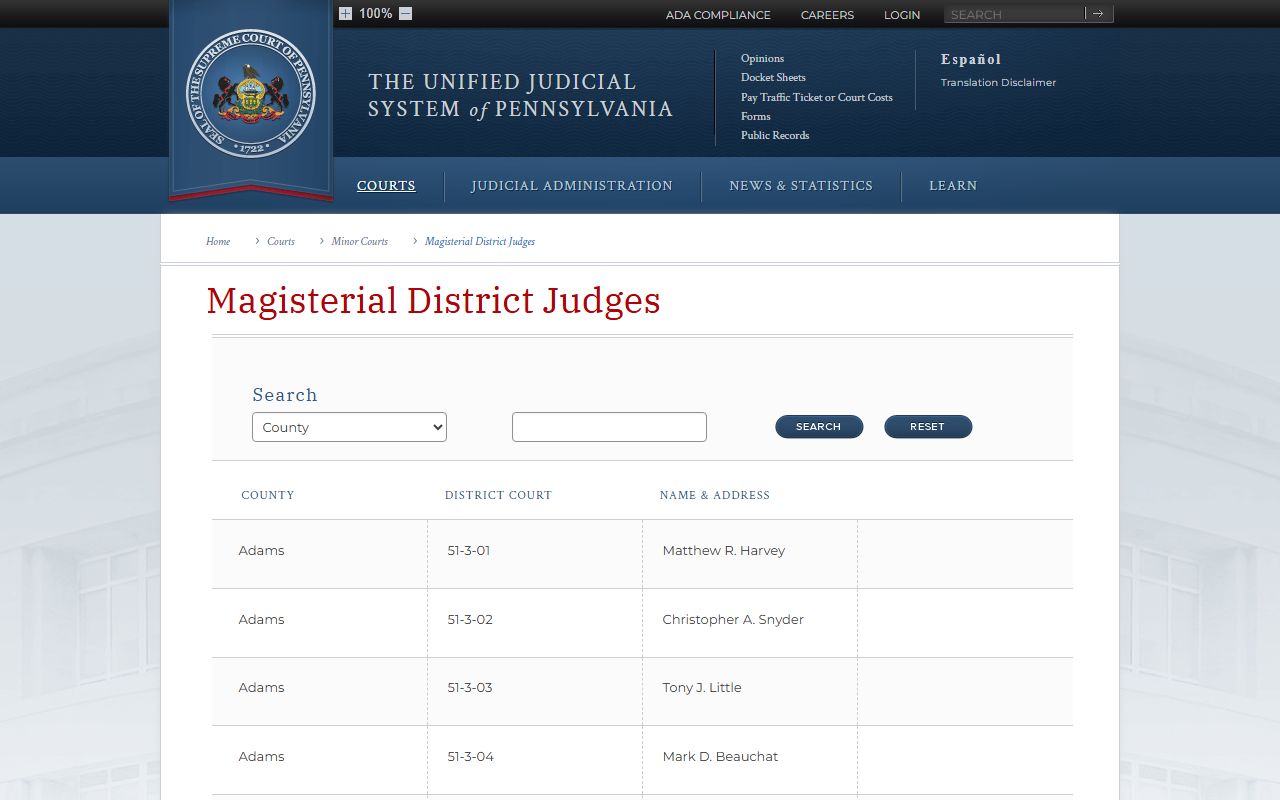
It frames how each district judge fits into the larger Unified Judicial System.
Full List of Luzerne County Magisterial District Courts
The county has many magisterial offices spread across its towns, from Wilkes-Barre to Hazleton to Mountain Top. Each office is run by one magisterial district judge. The table below lists every district, the judge, the office address, and the phone number. The full directory also appears on the county's Magisterial Offices page.
| District | Judge | Address | Phone |
|---|---|---|---|
| 11-0-01 | Central Court | 77 Water Street, Wilkes-Barre, PA 18702 | 272-808-2396 |
| 11-1-01 | Rick (Richard J.) Cronauer | 100 Hazle Street, 1st Fl., Wilkes-Barre, PA 18702 | 570-825-7373 |
| 11-1-02 | Thomas F. Malloy, Sr. | 100 Hazle Street, 2nd Fl., Wilkes-Barre, PA 18702 | 570-825-8488 |
| 11-1-03 | Allison L. Antolick | 615 East Broad Street, Hazleton, PA 18201 | 570-455-9467 |
| 11-1-04 | Alexandra Kokura Kravitz | 35 Broad Street, Pittston, PA 18640 | 570-655-0552 |
| 11-1-05 | Joshua R. Moses | 57 Russell Street, Edwardsville, PA 18704 | 570-287-2800 |
| 11-1-06 | David A. Barilla | 2009 Wyoming Avenue, Forty Fort, PA 18704 | 570-287-2341 |
| 11-2-01 | Matthew J. Carmody | 555 Exeter Avenue, West Pittston, PA 18634 | 570-655-0177 |
| 11-2-03 | Kyle Halesey | 1460 Sans Souci Parkway, Hanover Twp., PA 18706 | 570-825-8890 |
| 11-3-01 | Carol A. Davenport | 33 West Union Street, Shickshinny, PA 18655 | 570-542-4349 |
| 11-3-02 | Donald L. Whittaker | 15 East Ridge Street, Nanticoke, PA 18634 | 570-735-7648 |
| 11-3-03 | Daniel O'Donnell | 415 West Butler Drive, Drums, PA 18222 | 570-788-1191 |
| 11-3-04 | James M. Dixon | 789 Airport Road, Hazle Twp., PA 18202 | 570-455-9191 |
| 11-3-06 | Ferris P. Webby, Sr. | 321 South Mountain Blvd., Mountain Top, PA 18707 | 570-474-6844 |
| 11-3-07 | Michael G. Dotzel | 240 Johnson Street, Wilkes-Barre Twp., PA 18702 | 570-825-8671 |
| 11-3-08 | Joseph D. Spagnuolo, Jr. | 90 Maffett Street, Suite 1, Plains, PA 18705 | 570-825-8984 |
| 11-3-09 | Brian J. Tupper | 11 Carverton Road, Trucksville, PA 18708 | 570-696-4477 |
Note: A traffic or summary citation tells you which district court it came from, so match the district code to find the right office.
Court of Common Pleas vs. Magisterial District Court
The two court levels do very different work. The Court of Common Pleas hears the major cases and acts as the appeal court for minor-court decisions. The Magisterial District Court is the entry point for small and minor matters. Knowing the split helps you figure out where a case lives and where to file. The table below sets the main points side by side.
| Court of Common Pleas | Magisterial District Court | |
|---|---|---|
| Civil Limit | No fixed cap | Up to $12,000 |
| Criminal Role | Felonies and serious cases, trials, sentencing | Citations, complaints, bail, preliminary hearings |
| Family Cases | Yes, including divorce and custody | No |
| Appeals | Hears appeals from minor courts | Decisions can be appealed up |
How a Case Moves Through the System
A case rarely starts at the top. Most criminal cases begin with an arrest and a trip to a magisterial district judge. The judge sets bail and holds a preliminary hearing. If the case has enough weight, it moves up to the Court of Common Pleas for arraignment, pretrial steps, and trial. Civil cases follow a different track but share the same idea of moving from filing to judgment, with appeals at the end.
Criminal flow: Arrest › Preliminary Arraignment (often at Central Court) › Preliminary Hearing › Common Pleas Arraignment › Pretrial › Trial › Sentencing › Appeal to Superior Court
Civil flow: Complaint Filed › Answer › Discovery › Pretrial Conference › Trial › Judgment › Appeal
Appeals from Common Pleas usually go to the Superior Court of Pennsylvania for criminal, civil, and family matters. Government and public-law cases go to the Commonwealth Court. The Supreme Court of Pennsylvania may then take a case on discretionary review.
Divisions and Specialty Courts in Luzerne County
The Court of Common Pleas splits its work into divisions. The criminal division hears charges filed by police and the District Attorney. The civil division handles lawsuits, contracts, and property disputes. The family division covers divorce, custody, support, and Protection From Abuse. The Orphans' Court division handles estates, guardianships, and adoptions, working with the Register of Wills.
The court also runs problem-solving courts. Treatment Court combines criminal-justice staff and treatment providers; in 2013 it became the 5th court system in Pennsylvania accredited by the State Supreme Court. The Veterans Track pairs each veteran with a volunteer mentor, with care coordinated through the U.S. Department of Veterans Affairs. There is also a Mental Health Court and a juvenile-focused Wellness Court. Probation Services runs the DUI program. These tracks aim to treat root problems instead of just jailing people.
How to Look Up Luzerne County Court of Common Pleas Cases
Most Common Pleas cases can be tracked online for free. The main tool is the Pennsylvania UJS Web Portal Case Search. It pulls public docket sheets for Common Pleas criminal cases, magisterial dockets, traffic citations, and appellate matters. You can search by docket number, by participant name, by citation number, or by OTN. To narrow a search, pick County as Luzerne or set the Judicial District to 11. The portal is free to view, though some case types do not display.
Luzerne County Common Pleas docket numbers start with CP-40, since 40 is the county code. Magisterial dockets start with MJ-111. You can open the portal at the UJS Web Portal Case Search. The system warns that juvenile cases, expunged cases, limited-access cases, and Common Pleas civil cases may not show up for legal or technical reasons. For civil case documents, the county Prothonotary keeps a separate online viewer.
Not every record lives online. Older files and full filed documents come from the row offices, not the docket portal.
- Open the UJS Web Portal and choose a Search By type, such as Docket Number or Participant Name.
- Set County to Luzerne, or use Judicial District 11, to limit the results.
- Pick the Docket Type, like Criminal or Traffic, if you know it.
- Open the matching docket and view or print the docket sheet.
Note: A docket sheet is a summary; for a certified or full copy of a filing, contact the clerk office that holds the case.
Federal Courts Serving Luzerne County
Not every case for a Luzerne County resident is heard in the county system. Federal matters go to the U.S. District Court for the Middle District of Pennsylvania. The Wilkes-Barre divisional courthouse is the Max Rosenn U.S. Courthouse at 197 South Main Street. Bankruptcy goes to the U.S. Bankruptcy Court for the Middle District of Pennsylvania. Federal appeals go to the U.S. Court of Appeals for the Third Circuit.
Federal cases are not in the county Prothonotary or Clerk of Courts systems, and they will not appear in the state UJS portal. Federal dockets are accessed through PACER. So if you cannot find a case in the county tools, the matter may be federal. The county trial court and the federal court run on separate record systems.