
What Probate Covers in Luzerne County
Probate is the legal process of settling the estate of someone who has died. In Pennsylvania there is no separate "probate court." Instead, the work runs through the Register of Wills, who also acts as the Clerk of Orphans' Court. When a person dies, the Register of Wills appoints a personal representative to gather assets, pay debts, and pass on what is left. An estate is probated in the county where the person lived. For a Luzerne County resident, that means the local Register of Wills.
The office handles more than wills and estates. It also takes in inheritance tax returns and manages filings tied to guardianships and adoptions. Contested estates, guardianship cases, and disputes over accounts can move into Orphans' Court for a judge to decide. Probate records make up a large share of what the office keeps, and many of those files are open to the public for research. The Register of Wills can confirm whether an estate was opened and point you to the file.
Probate Terms Defined
Probate paperwork uses words that may be new to you. A few short definitions make the records easier to read and help you ask the office the right questions. The terms below show up across most estate files.
- Testator
- The person who made the will. The will states how the testator wants property handled after death.
- Executor
- The person named in the will to carry it out, gather assets, pay debts, and distribute what remains.
- Administrator
- The person the Register of Wills appoints to settle an estate when there is no will or no named executor able to serve.
- Intestate
- Dying without a valid will. State law then sets who inherits the estate.
- Short Certificate
- A document that proves a personal representative's authority. One is usually needed for each bank or financial firm.
- Guardian
- A person a court appoints to handle the affairs of a minor or an adult who cannot manage their own.
How to Search Luzerne County Probate Records
You can search Luzerne County probate records online or in person. Estate records from 2004 to the present are available online, and the office's indexes reach back to 1875 through the IQS Infodex system. Marriage records in the same office go back to 1885. For files older than the online range, or for full document copies, you contact the Register of Wills directly. The steps below outline a typical search.
- Decide what you need: an estate file, a will, a short certificate, or an index entry.
- For estates from 2004 on, use the online estate records; for older entries, use the IQS Infodex index back to 1875.
- Contact the Register of Wills at 570-825-1668 to confirm a file or order certified copies.
When you search, the name of the decedent and an approximate year of death help the most. If you cannot find a file online, the office can run a search for a fee. Land records tied to an estate, such as deeds passing to heirs, are kept by the Recorder of Deeds and can be reached through Landex remote access.
Register of Wills and Orphans' Court
The Register of Wills and Clerk of Orphans' Court sits in the county courthouse in Wilkes-Barre. This is the single office for opening an estate, filing a Petition for Grant of Letters, ordering short certificates, and paying inheritance tax. Staff can explain which forms a given estate needs. The county's Clerk of the Orphans' Court page is a good starting reference for estate filings.
Register of Wills / Clerk of Orphans' Court
153 North River Street
Wilkes-Barre, PA 18711
570-825-1668
Mon-Fri 9:00 a.m. to 4:30 p.m.
The Clerk of Orphans' Court page covers the records the office keeps and how the public can reach them. The image below comes from that county page.
The county's official Clerk of the Orphans' Court page lays out the office's role in estates, guardianships, and adoptions. Visit the Clerk of the Orphans' Court page for the source.
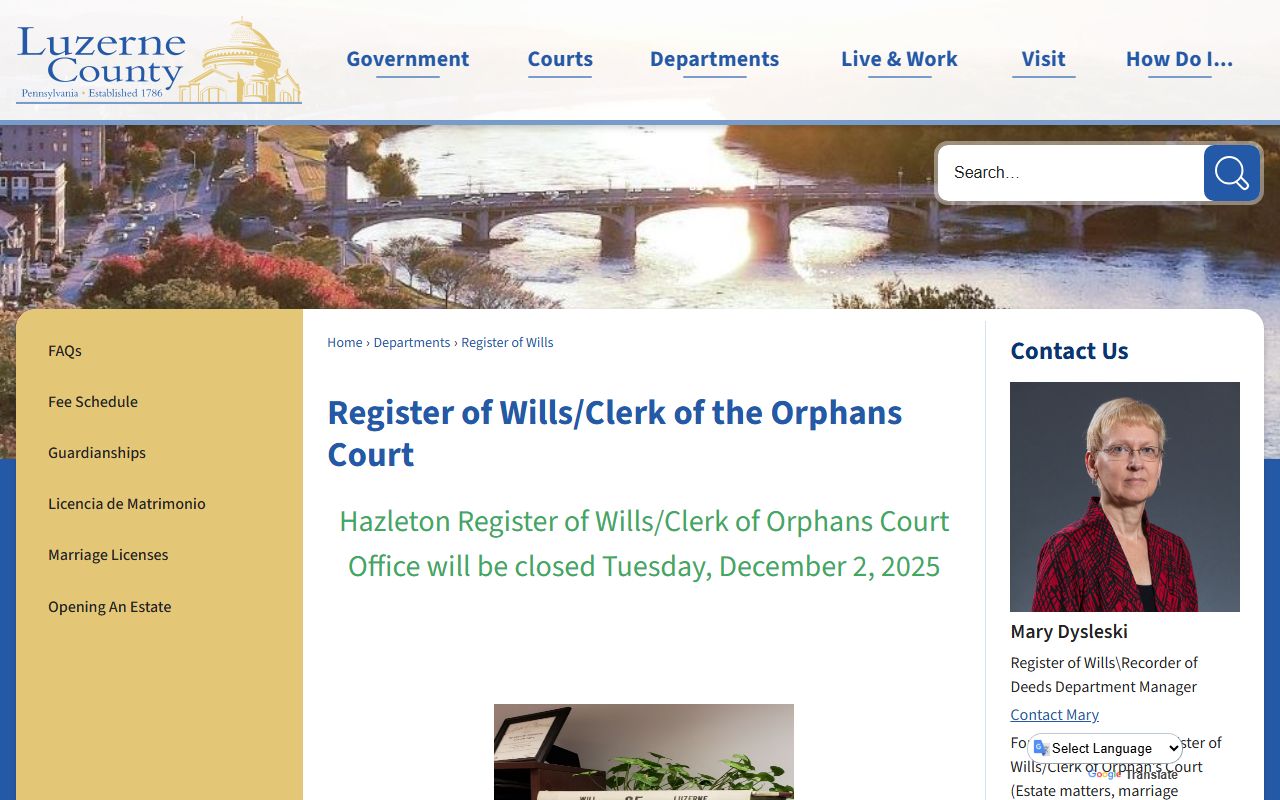
That page is the front door for Luzerne County probate records, from opening an estate to ordering a certified copy.
Luzerne County Probate Filing Fees
Probate fees in Luzerne County are graduated, which means the charge rises with the value of the gross estate. A small estate pays the base fee, while a large one pays more. The schedule below took effect August 1, 2023. Other set fees apply to specific filings, such as a will-only probate, a short certificate, an inheritance tax return, and guardianship or adoption petitions.
| Estate value | Probate fee |
|---|---|
| $25,000 or less | $50.00 |
| $25,001 - $50,000 | $85.00 |
| $50,001 - $75,000 | $120.00 |
| $75,001 - $100,000 | $155.00 |
| $100,001 - $200,000 | $190.00 |
| $200,001 - $400,000 | $260.00 |
| Each added $200,000 (or part) | +$50.00 |
Other common charges include a will-only probate at $50.00, a small estate petition at $50.00, a short certificate at $5.00, an inheritance tax return at $10.00, a guardianship petition at $50.00, a petition for adoption with a number at $150.00, and a search fee at $20.00.
How Probate Works in Luzerne County
Opening an estate follows a set order. The personal representative files with the Register of Wills, pays the graduated fee, and then handles the estate's debts, taxes, and distributions over time. The steps below show the typical path for a Luzerne County estate.
- Confirm the decedent was a Luzerne County resident.
- Find out whether there is a will and who is named as executor.
- File a Petition for Grant of Letters with the Register of Wills. Letters testamentary apply when there is a will; letters of administration apply when there is none.
- Pay the graduated probate fee based on the estate's value.
- Receive the Letters and any short certificates if the petition is accepted.
- Give required notices, then handle inventory, inheritance tax, claims, accounting, and distribution.
- For contested estates, guardianships, adoptions, or accounts, expect Orphans' Court involvement.
Note: A short certificate is usually needed for each financial institution, so a representative often orders several at $5.00 apiece.
What Luzerne County Probate Records Show
An estate file builds up as the case moves along. Early on it holds the will, if there is one, and the Petition for Grant of Letters. After that come the Letters themselves, an inventory of assets, the inheritance tax return, and accountings that track money in and out. The final records show how property was distributed to heirs.
Probate records can also tie into other county files. A deed may record property passing to an heir, and a guardianship file may sit alongside an estate. Because the Register of Wills also keeps marriage records, a single visit can cover more than one need. For broader case research, the court records page explains the county's public docket tools.
Inheritance tax is part of most estates. Pennsylvania charges the tax on assets that pass at death, and the rate depends on who inherits. The estate files an inheritance tax return, and the Register of Wills takes that filing for a set fee. The personal representative also tracks claims from creditors and files an accounting that shows every dollar that came in and went out. Heirs can review that accounting to confirm the estate was handled the right way.
Restricted Probate Records
Most estate files are open to the public, but some parts carry limits. Records that involve a minor's guardianship, an adoption, or sensitive medical or mental health details may be sealed or kept from open view. Adoption files in particular are tightly closed. When a record is restricted, the office can tell you what is available and what stays private.
If you need a copy of a limited record, you may have to show a legal interest or get a court order. The Register of Wills staff can explain the rules for a given file type. For estate matters that overlap with marriage, the marriage and divorce records page covers those requests, and the Prothonotary & Clerk of Courts page covers civil filings.
Guardianship and adoption cases get extra care for good reason. They involve children or adults who cannot speak for themselves, so the court guards their privacy. A guardianship petition opens a case to name someone to manage a person's affairs. An adoption petition with a number carries its own fee and a closed file. Both run through Orphans' Court, and both can require a hearing before a judge signs off.