
Pennsylvania Right-to-Know Law
Pennsylvania's open-records framework is the Right-to-Know Law (RTKL), found at 65 P.S. §§ 67.101 et seq. and passed as Act 3 of 2008. It treats most government-agency records as public unless a clear exemption applies. The law is administered with appeal help from the Pennsylvania Office of Open Records (OOR). Under the RTKL, an agency must respond to a written request within 5 business days. The agency may take a 30-calendar-day extension in some cases.
If the office does not respond within 5 business days, the law treats that silence as a "deemed denial." A requester may then appeal to the OOR within 15 business days. The OOR cannot charge a fee for the agency's review of a request. Duplication fees follow the OOR fee schedule. Anyone can file a request, but Luzerne County does not accept anonymous requests, so you must give your name and contact details.
The state explains the law and the appeal route on the Office of Open Records site. 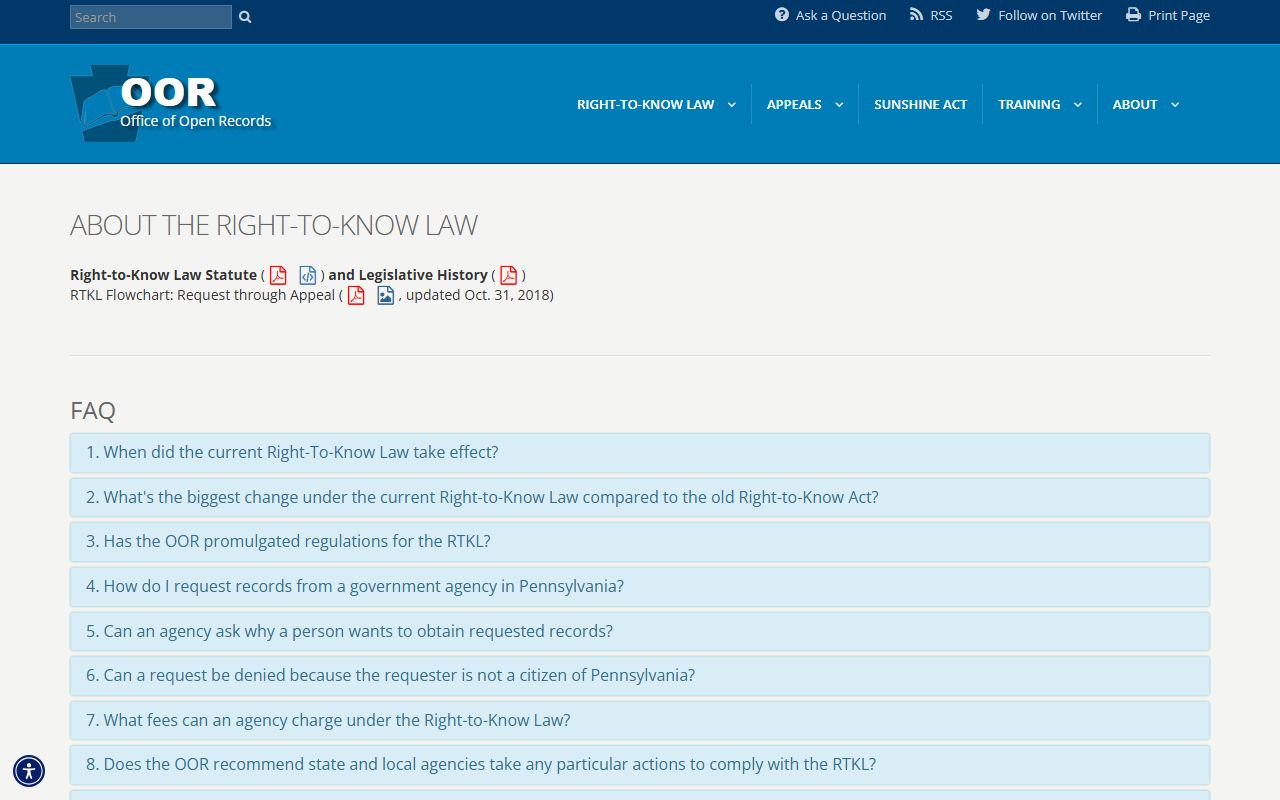 That page is the authority on deadlines, fees, and how to appeal a denial, and it backs the rules described here.
Court Records Are Not a Right-to-Know Request
This is the split that trips people up. The RTKL covers ordinary government records, but it does not cover court case records. Those are governed by the Case Records Public Access Policy of the Unified Judicial System, set out at 204 Pa. Code § 213.81. Court files come from the county row offices and the statewide UJS portal, not from a Right-to-Know request.
So if you want a criminal docket, a civil case file, or a court order, you do not file an RTK request. You go to the right row office or search the court system directly. For an overview of those options, see Luzerne County court records. Under the UJS access policy, photocopy and print fees shall not exceed $0.25 per page unless a rule sets a different rate. Mixing up the two systems just slows your request down.
What Records Luzerne County Keeps
Beyond court files, several county row offices hold records the public uses every day. The Recorder of Deeds records land documents. The Register of Wills / Clerk of Orphans' Court handles wills and estates and issues marriage licenses. The Prothonotary and Clerk of Courts keep civil and criminal court files, which route through the court access policy rather than RTK. Vital records like marriage and certain certificates are held at the county level here, not only by the state.
- Deeds, mortgages, satisfactions, and UCC financing statements (Recorder of Deeds)
- Wills, estates, short certificates, guardianships, and adoptions (Register of Wills / Orphans' Court)
- Marriage licenses and certified marriage copies (Register of Wills)
- Civil, family, and criminal court files (Prothonotary and Clerk of Courts)
- Notary and official commissions (Recorder of Deeds)
The county describes the land-records office and its services on the Recorder of Deeds page. 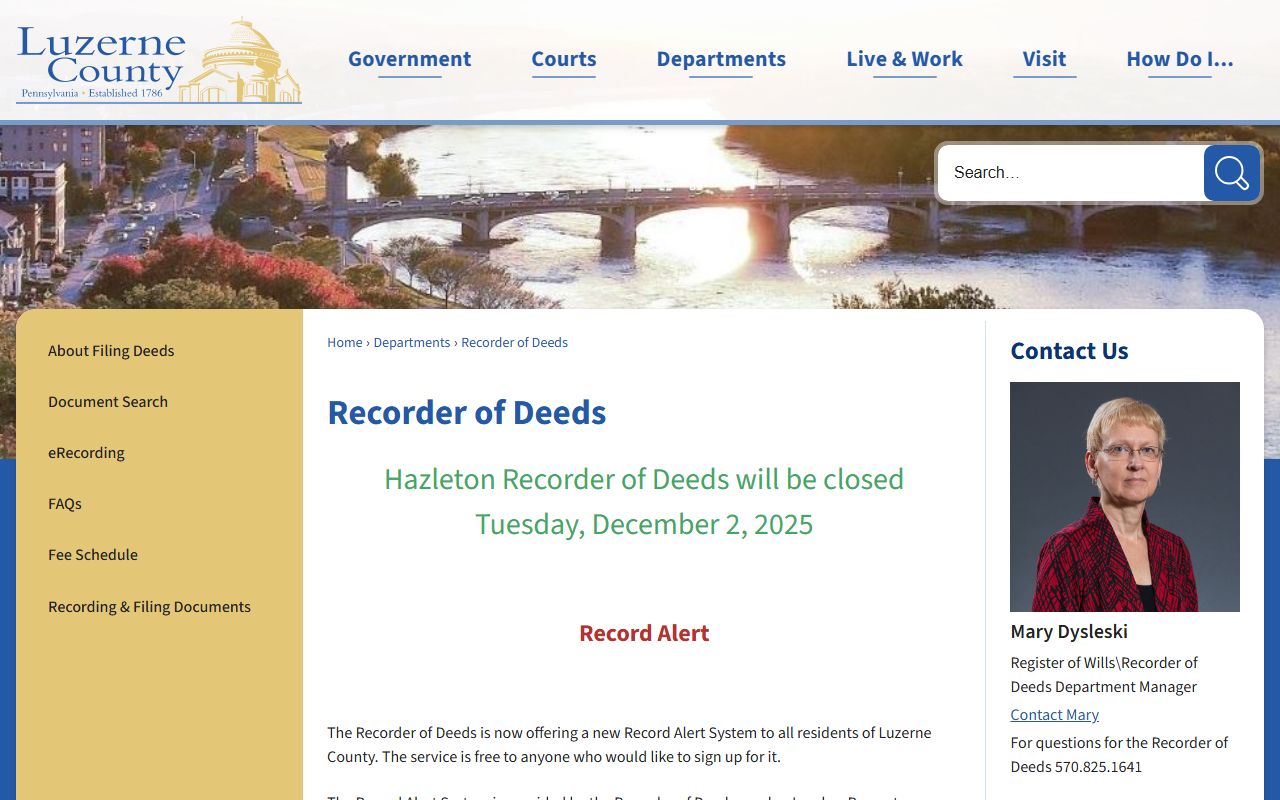 That office is where deeds, mortgages, and UCC filings are recorded and copied, and it is a core source of county public records.
The land records and probate files are searchable in part online and in part at the office. For estate and probate filings, see probate records. The Recorder of Deeds offers remote access through Landex and an IQS portal, with per-document fees that the office sets.
Where to Send Your Request
Luzerne County does not use one open-records officer for everything. The county names multiple Open Records Officers by record type. General county records run through an officer in the Office of Law. Court-related records run through a separate officer in Court Administration. Sending a request to the wrong office wastes days, so check the routing table first.
| Record Type | Office |
|---|---|
| General county / agency records (RTK) | Office of Law (county Open Records Officer) |
| Court case records and court administration | Court Administration (court-records officer, under 204 Pa. Code § 213.81) |
| Deeds, mortgages, UCC filings | Recorder of Deeds |
| Wills, estates, marriage licenses | Register of Wills / Clerk of Orphans' Court |
| Civil and family court files | Prothonotary |
| Criminal court files, expungements | Clerk of Courts |
Note: Luzerne County does not accept anonymous Right-to-Know requests, so include your name and a way to reach you.
How to File a Public Records Request in Luzerne County
A clean request gets a faster answer. Put it in writing, name the records plainly, and send it to the correct officer. The county outlines its process on the Right-to-Know Law records request page. The steps below cover an ordinary RTK request for county records, not court files.
- Identify the right office. General county records go to the Office of Law; deeds go to the Recorder of Deeds; court files do not use RTK at all.
- Describe the records you want. Be specific about dates, names, parcel numbers, or document types so the office can find them.
- Put your name and contact details on the request, since the county does not accept anonymous requests.
- Submit the request by mail, email, or the county's process to the named Open Records Officer.
- Wait for the response. The office has 5 business days to grant, deny, or invoke an extension.
- Pay any duplication fees under the OOR schedule, then receive the records.
Public Records Request Form Fields
Most RTK requests use a short standard form. You can use the OOR's standard request form or the county's own form. Either way, a few fields drive how the office handles the request, and clear answers cut back-and-forth.
| Field | Required | Notes |
|---|---|---|
| Requester Name | Yes | No anonymous requests accepted in Luzerne County |
| Contact Information | Yes | Address, email, or phone so the office can reply |
| Description of Records | Yes | Be specific: dates, names, document type, parcel ID |
| Date Range | No | Narrows the search and may lower fees |
| Format Preference | No | Paper copy or electronic file |
Luzerne County Public Records Fees
Fees depend on which law and office handle your request. RTK duplication fees follow the OOR fee schedule, and the OOR cannot let an agency charge for the time it spends reviewing a request. Court records under the UJS access policy carry their own page rate. The row offices set their own copy and certification fees, which the county publishes in its fee schedules.
| Item | Amount |
|---|---|
| RTK duplication (per page) | Per OOR fee schedule |
| Court record copy (UJS policy) | Up to $0.25 per page |
| Recorder of Deeds copy (per page) | $0.50 |
| Recorder of Deeds certification | $2.00 |
| Register of Wills certified record | $25.00 |
| Register of Wills search fee | $20.00 |
Note: The OOR may not charge a fee for the agency's review of a request, though duplication and certification fees still apply per the schedules.
Response Timelines and Appeals
The RTKL gives an agency 5 business days to respond to a written request. The office can grant it, deny it, or take a 30-calendar-day extension when the law allows. No reply within 5 business days counts as a deemed denial, which you can treat as a "no."
If your request is denied or deemed denied, you may appeal to the Office of Open Records within 15 business days. The OOR reviews the appeal and issues a final determination, which either side can challenge in court. Court records do not follow this RTK path; access disputes there run through the courts under the UJS policy. For criminal record data, see criminal records.
A few habits make timelines work in your favor. Date your request and keep a copy, since the 5-business-day clock starts when the office gets it. Watch for an extension notice, which can push the answer out by up to 30 calendar days. If you hear nothing at all, do not wait past the deemed-denial point to act. The 15-business-day appeal window is firm, and missing it can end your shot at the records.
Records That Are Not Public
Not every record is open. The RTKL and other state laws shield several categories from release. Some court-linked records are restricted by their own rules, and those limits hold even when the underlying file would otherwise be public. Knowing the common exemptions saves you from filing a request that cannot be granted.
Court records carry their own confidentiality rules under the UJS access policy. Juvenile case records are restricted under 42 Pa.C.S. § 6307. Expunged records are removed under 18 Pa.C.S. § 9122, and limited-access or Clean Slate records are sealed from public view under §§ 9122.1 and 9122.2. Adoption records are withheld except as a statute allows. Personal identifiers like Social Security numbers, financial account numbers, and driver license numbers are masked. Criminal history data is its own track under the Criminal History Record Information Act, 18 Pa.C.S. Chapter 91.
Even when a record is sealed from the public, courts and law enforcement keep access. So a sealed criminal record still exists; it just does not show up in a public search. If a record falls into one of these buckets, an RTK request will not pry it loose.