
What Is a Court Docket in Luzerne County
A docket is the official log of a case. Each line, called a docket entry, marks one event. A filing, a hearing, a motion, an order, a bail action, a status change. The docket sheet pulls those entries into one view. It shows the case from start to finish in order. For Luzerne County court dockets, the header carries the docket number, the court, the county, the case caption, the filing date, and the case status. The body lists the parties, their roles, and the attorneys.
A docket differs from the full case file. The docket lists events. The full file holds the actual documents, the motions, the exhibits, and the signed orders. The Pennsylvania courts split docket types so each lands in the right place. Criminal, traffic, civil, landlord-tenant, and summary appeal each carry their own type. Common Pleas dockets and Magisterial District Court dockets use different number formats, which matters when you search. One reads CP-40, the other reads MJ.
How to Find Luzerne County Dockets Online
The main tool is the Pennsylvania UJS Web Portal Case Search. It is free to search and free to view docket sheets. It covers Common Pleas criminal dockets, Magisterial District Court dockets, traffic citations, and appellate cases. You can search by docket number, participant name, citation number, OTN, or date filed. Set the county to Luzerne, or judicial district 11, to focus the results. The portal warns that some cases, such as juvenile, expunged, limited-access, and Common Pleas civil cases, may not display.
Pennsylvania also offers guidance on Common Pleas docket sheets, including how to read and request them. The state explains the process on its Common Pleas docket sheets page.
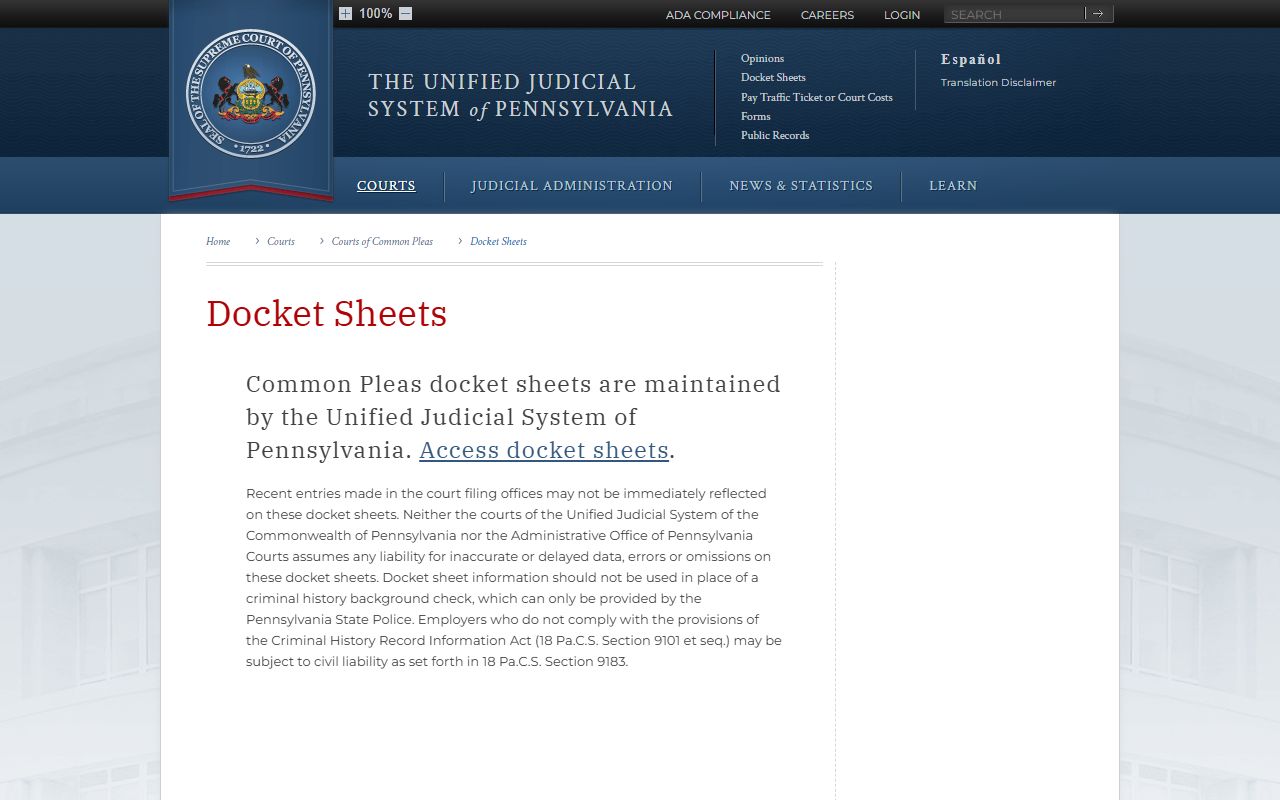
That page connects to the same UJS case search and clarifies what a docket sheet contains. Use these steps to pull a Luzerne County docket.
- Open ujsportal.pacourts.us/CaseSearch and choose a Search By type.
- Pick the court or docket type, such as Criminal, Traffic, or Magisterial.
- Enter a docket number, or use a participant name with county set to Luzerne.
- Open the result and review the docket entries from top to bottom.
Sample Luzerne County Docket Entry
Each docket entry reads like a short note. It tells you the date, the event, who acted, and whether a document is attached. Read down the list to follow the case in time. Criminal dockets add metadata like the OTN, the charges, the grading, and the disposition. Traffic dockets show the citation number, the offense, and the amount due or paid. Some identifiers stay masked. SSNs, financial account numbers, driver license numbers, SID numbers, and minors' names are confidential under UJS policy. This sample shows what the parts of a Luzerne County docket entry mean.
| Field | What It Shows |
|---|---|
| Entry Date | The date the event was logged on the docket |
| Event Type | The action, such as a hearing, motion, order, or continuance |
| Party Filing | Who filed or acted, such as the plaintiff, defendant, or Commonwealth |
| Document Link | Whether a filed document is attached; full files come from the row office |
| Disposition | The outcome of a charge or count, where one is recorded |
| Financials | Bail actions, costs, fines, and restitution tied to the entry |
The docket sheet gives a view-and-print copy. To get the full filed documents, you go to the county office that holds them, the Prothonotary for civil cases or the Clerk of Courts for criminal cases.
Courts That Publish Dockets in Luzerne County
Luzerne County is the 11th Judicial District. Its trial court is the Court of Common Pleas in Wilkes-Barre. Below it are the Magisterial District Courts, numbered 11-X-XX, the local minor courts. Both levels feed dockets to the statewide UJS portal. Above Common Pleas sit the appellate courts, which also post dockets through the same system. The county also keeps a courts landing page with hours and links. You can reach it at the Luzerne County Courts page.
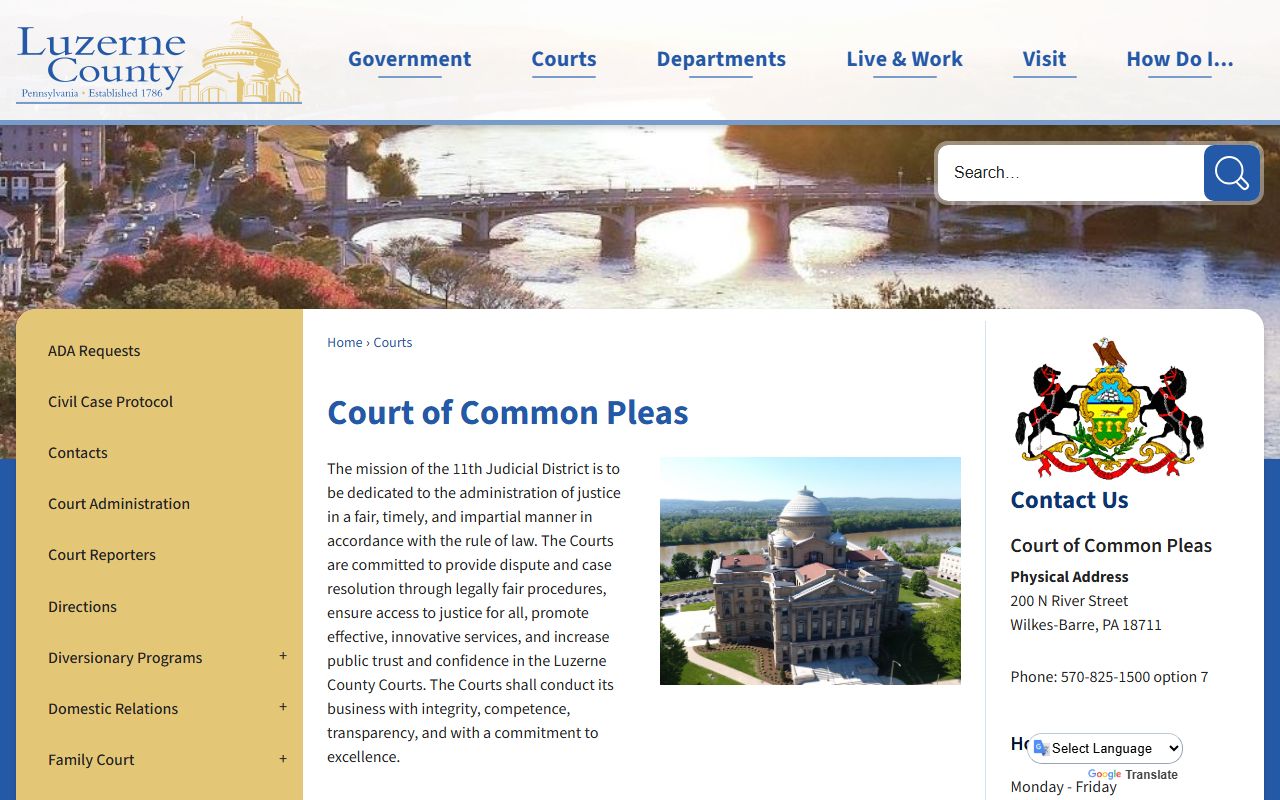
That page lists court offices, hours, and the UJS docket links the county points to. Here is how docket access lines up across the courts that serve Luzerne County.
- Court of Common Pleas: criminal, civil, family, and Orphans' Court cases; criminal dockets post to UJS as CP-40, while civil and family stay limited online.
- Magisterial District Courts: traffic, non-traffic, landlord-tenant, and small claims to $12,000; dockets post to UJS as MJ-111xx.
- Appellate courts: Superior, Commonwealth, and Supreme Court matters, searchable through the UJS appellate option.
- Federal courts: cases for county residents go to the Middle District of Pennsylvania and are found through PACER, not the county or state systems.
Docket vs. Full Case Record
People mix up the docket and the case file, but they are not the same. The docket is a list of events. The full case record is the stack of documents behind those events, the motions, the exhibits, and the signed orders. The docket tracks what happened. The full file shows the substance. For Luzerne County, the UJS docket is often free and online. The full documents may require a fee, an account on the county viewer, or a trip to the courthouse. This table lays out the difference.
| Docket | Full Case Record | |
|---|---|---|
| Format | List of entries | Full documents |
| Access | Often online and free | May require fee or visit |
| Use | Track case progress | Legal review, evidence |
Note: A docket search through UJS is free, but certified copies of court documents carry a fee at the county office, such as $9.00 for the first certified page at the Prothonotary.
How to Read a Luzerne County Docket
Dockets use shorthand. Once you know the terms, they read fast. The OTN is the offense tracking number that ties a criminal case across systems. A continuance means a hearing got moved to a later date. A disposition is the outcome of a charge, like a plea, a verdict, or a dismissal. Bail actions show whether bail was set, posted, or revoked. The grading marks an offense as a summary, a misdemeanor, or a felony. Common Pleas docket numbers carry the CP-40 prefix, since 40 is the Luzerne County court code.
Magisterial dockets read a bit differently. They start with MJ and the district number, such as MJ-11101. These cover citations, landlord-tenant disputes, and the early steps of a criminal case, like the preliminary arraignment and preliminary hearing. A case can start at the magisterial level and move up to Common Pleas. When that happens, a new CP-40 docket opens. Watch the case status too. Active, closed, inactive, and adjudicated each tell you where the case stands. President Judge Stefanie J. Salavantis leads the Common Pleas bench that issues these orders.
A few more terms come up often. The case caption names the parties, like Commonwealth versus a defendant in a criminal case, or one party versus another in a civil case. The Commonwealth stands in for the prosecution in criminal matters. Costs and restitution show what a defendant must pay. A surety is the person or bond that guarantees bail. When you see an order entry, it marks a decision by the judge. Reading the entries in date order shows how a case moved from filing to disposition. The free dockets came from the statewide system once the Prothonotary computerized its civil records back on March 1, 2005.